My automatic gate has stopped closing. What is wrong?
A gate that opens normally but refuses to close is far more often a photocell fault than a motor fault. A dirty, misaligned or water damaged photocell reads as a permanent obstruction in the opening, and the gate does exactly what it is designed to do and stays open. That is usually a clean, a realignment or a replacement photocell rather than a new drive.
My gate has dropped and is catching on the ground. Can it be fixed?
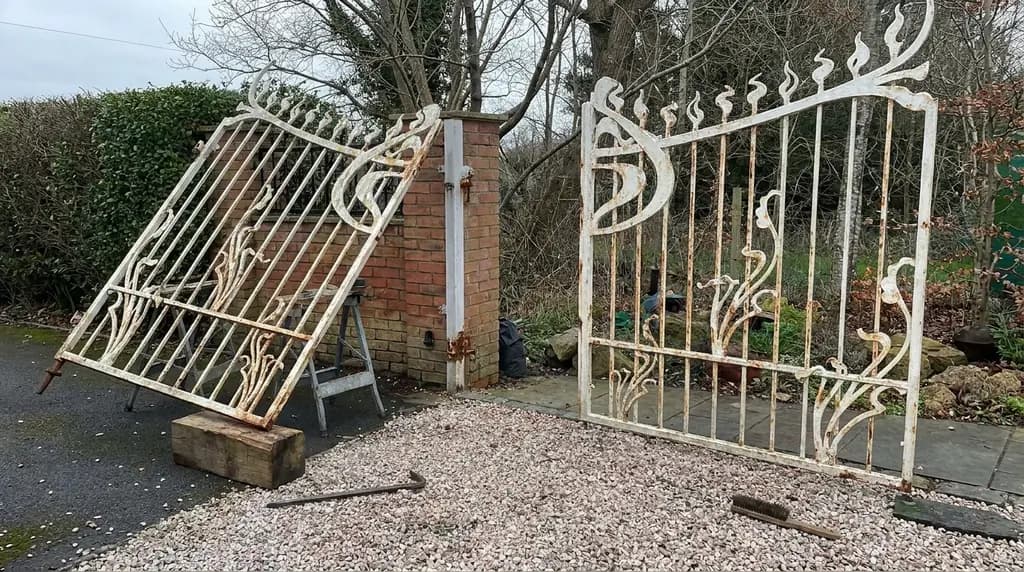
Yes, a dropped gate is one of the most common repairs and it is usually the hinge or the post rather than the gate leaf. Heavy gates put a large leverage load on the hinge point, so bearings wear, fixings work loose in masonry and timber posts lean over time. Depending on the cause the fix is a hinge or bearing replacement, re-fixing into sound masonry, or replacing the post with one sized for the load.
Can you repair any make of gate motor?
Repairs are not tied to a particular manufacturer or to whoever installed the gate. Drives, control boards, photocells, safety edges, racks, rollers, hinges and cabling can all be repaired or replaced across the common makes on UK driveways. Where a specific part is genuinely obsolete, a compatible replacement drive can usually be fitted while keeping the gates, posts and existing cable run.
Is it worth repairing an old gate or should I replace it?
Repair is usually the right starting point, because the expensive parts of a gate installation are the gates, the posts and the buried cabling, and a failed motor or control board rarely damages any of those. Replacing a single failed component and keeping everything else costs far less than a new system. Full replacement makes sense when the gates themselves are beyond repair, or when several parts of an old system are failing in turn.
One gate leaf opens and the other does not. What causes that?
A single leaf failing usually points at that leaf's motor, its cabling or its limit settings, rather than at the control board serving both. Common causes are a failed capacitor in the motor, water ingress at the cable gland, a damaged cable where it crosses the gate hinge point, or travel limits that have drifted. It is a diagnosis job on site, because the same symptom comes from several different faults.
My gate was hit by a vehicle. Can it be repaired?
Impact damage can usually be repaired, and how much is salvageable depends on whether the force went into the leaf, the hinge or the post foundation. A bent leaf on a wrought iron gate can often be straightened and re-welded, while a post that has been shifted in its foundation normally needs digging out and re-casting. The motor should always be checked after an impact even if it still runs, because the drive takes a large shock load when the gate is forced.
Water has got into my control box. Is the board ruined?
Not always, though water ingress is one of the more common causes of control board failure on gates over a few years old. Corrosion is progressive, so a board caught early sometimes survives once it is dried, cleaned and the source of the water is sealed. What matters more than the board itself is finding how the water got in, because a failed gland, a cracked enclosure or a missing lid will simply destroy the replacement too.
My remote has stopped working. Does that mean the gate has failed?
A remote that has stopped working is usually the fob rather than the gate, and the first thing to try is a fresh battery and a second fob if you have one. If every fob has stopped at once, the fault is more likely to be the receiver, its aerial, or the aerial cable, which is often damaged where it runs along a gate post. Testing whether the gate still runs from a keypad, intercom or the control board itself narrows it down quickly.
How do I open my gate while it is broken?
Use the manual release, which every automatic gate has, so the drive can be disengaged and the gate pushed by hand. On most systems it is a keyed lever or a cover on the motor casing, and on underground drives it is usually accessed at the pivot box. If you cannot find or work the release, do not force the gate against the drive, because that can damage the gearbox and turn a small repair into a replacement.
Does a gate need re-testing after a repair?
Yes, any repair that touches the drive, the control board, the safety devices or the gate's weight and movement changes the forces the gate applies, so those forces need re-checking. Replacing a motor or a control board resets the travel limits and the obstacle detection settings, which are the exact settings that keep the gate within the limits in BS EN 12453. A gate should leave a repair working safely as well as simply working.
How quickly can a broken gate be repaired?
It depends on the fault and on whether the parts are in stock, so the sensible first step is a phone call describing the symptoms. Faults such as photocell misalignment, loose fixings or limit settings are often resolved on the first visit. Replacement motors, control boards and obsolete parts have to be ordered, which means a return visit, and in the meantime the gate can normally be left on manual release so the driveway stays usable.
What affects the cost of a gate repair?
Repair cost comes down to what has failed, whether the part is a stock item or an obsolete one, and how much work is needed to get at it. A photocell realignment or a hinge adjustment is at the small end, an underground motor replacement that needs the box excavated and drained is at the other. Diagnosis on site is what settles it, because the same symptom can be a five minute adjustment or a failed drive.