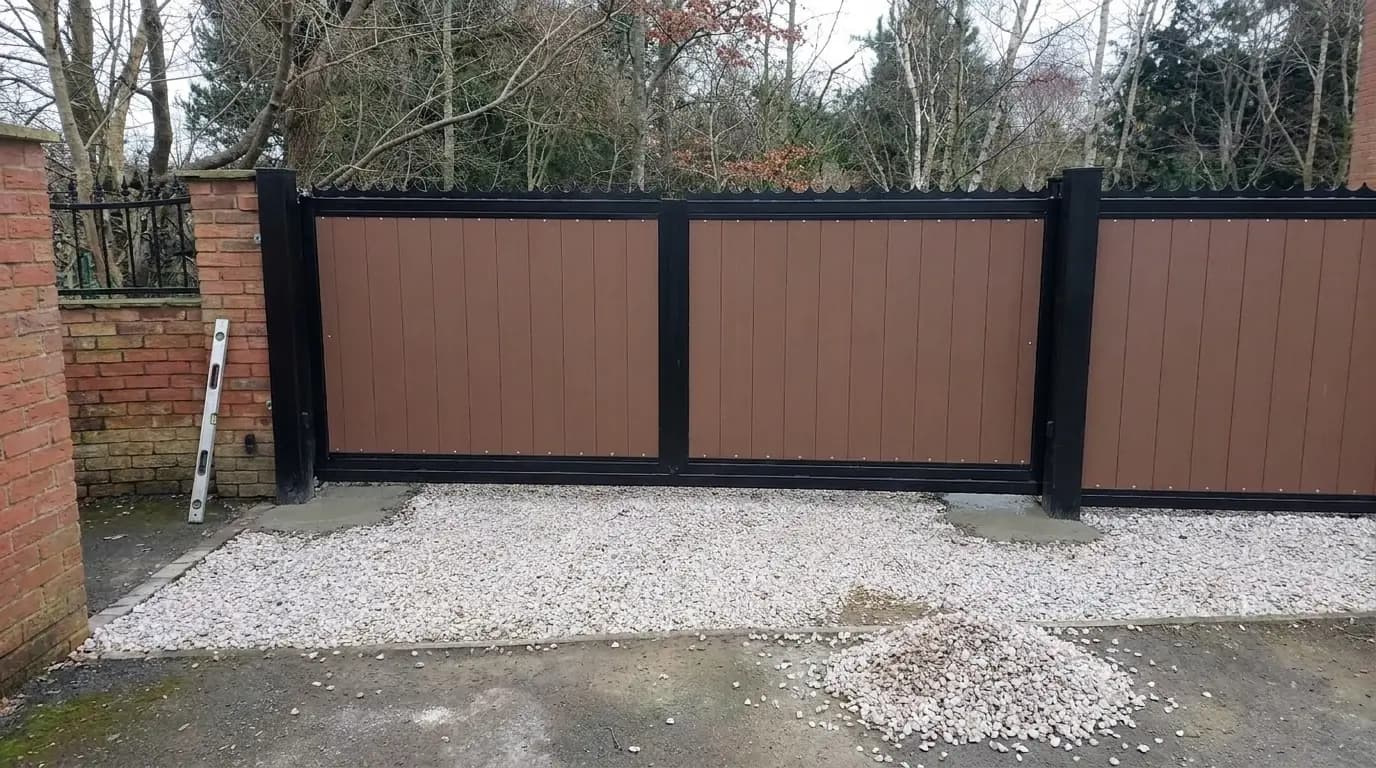
Do you supply the gates as well as fit them?
Yes, gates can be supplied and fitted as one job, which is how most driveway gate installations are done. Supplying and fitting together means the gate is sized to the opening that was actually measured, and the posts, hinges and fixings are specified to suit the weight of that gate rather than whatever the box arrived with. It also means one point of contact if anything needs adjusting after the gates have settled.
Can I just buy gates without installation?
Gates can be supplied on their own, but it is worth understanding what you take on when you do. Driveway gates are heavy, they need posts or pillar fixings sized to the leaf weight, and the hanging is what determines whether they still close properly in two years. If you are fitting them yourself, get the opening measured and the post specification agreed before ordering, because a gate made to the wrong opening cannot be stretched.
I have already bought gates online. Will you fit them?
Gates bought elsewhere can usually be fitted, as long as they are the right size for the opening and the ironwork is sound. The two things worth checking before you order are the true opening width including pillars, and the hinge arrangement, because some imported gates come with hinges that suit a masonry pillar and others expect a steel post. If you want the gates automated later, say so before ordering, since a few designs leave nowhere sensible to mount a motor.
Is it cheaper to supply my own gates and pay only for fitting?
Sometimes, but the saving is often smaller than it looks once the extras are counted. A supplied and fitted job includes posts or pillar fixings matched to that specific gate, and any adjustment to the ironwork needed to make it hang correctly. Where a self bought gate arrives undersized, oversized or with unsuitable hinges, the fitting cost goes up and the saving disappears.
What gate materials are worth considering?
The realistic choices for a UK driveway are wrought iron, timber, composite board and aluminium, and the decision is mostly about maintenance and appearance rather than strength. Wrought iron needs repainting every few years but can be repaired almost indefinitely and takes automation well. Composite and aluminium need very little upkeep and stay dimensionally stable, while timber looks right on rural and cottage entrances but moves with the weather and needs treating.
Should I automate at the same time as fitting new gates?
Fitting the gates and the automation together is almost always cheaper and neater than adding a motor later. Doing both at once means the posts are sized for the load from the start, the ducting goes in before the ground is made good, and the power cable is run once. If the budget will not stretch to automation yet, the next best thing is to have the ducting and cable installed now and the motor added later.
Do I need planning permission for driveway gates?
In most cases no, because gates, walls and fences up to one metre high next to a highway used by vehicles, or up to two metres elsewhere, normally fall under permitted development in England. Permission is more likely to be needed if the property is listed, in a conservation area, or if permitted development rights have been removed by a condition on the original planning consent. Since the rules turn on your specific property, the safe step is a quick check with your local planning department before ordering.
How deep do gate posts need to go?
There is no single figure, because the right foundation depends on the weight and width of the leaf it carries, the ground conditions and whether the gate will be automated. A pair of heavy iron gates exerts a large leverage load on whatever they hang from, which is why the post is the most common cause of a gate failing early rather than the gate itself. Undersized or shallow set posts drop out of alignment within a season, and by then the gate is catching on the ground and the drop cannot be adjusted out.
How does wind affect a driveway gate?
Wind loading matters a great deal on solid gates, because a closed board or panel gate acts as a sail and transfers that force straight into the posts and hinges. Exposed rural entrances, and anywhere on the coastal plain or in the South Lakes valleys, see enough wind to bend an undersized frame or work a post loose. Where wind is a concern the answer is usually a partly open infill design, or heavier posts and larger foundations under a solid gate.
Should I have swing gates or a sliding gate?
Swing gates suit most driveways and cost less, but they need clear space behind the opening for the leaves to swing into. A sliding gate is the answer where the drive is short and runs straight onto a road, where the ground rises steeply behind the entrance, or where cars regularly park close to the gate line. Sliding gates need clear run off space to one side instead, roughly the width of the opening again, so the site decides this more than preference does.
How long does a gate installation take?
A typical pair of driveway gates fitted to existing sound pillars is a one day job, and a full installation with new posts, foundations and automation usually runs to two or three days. Concrete needs time to cure before heavy gates are hung on new posts, so on some jobs the work splits across two visits with a gap between them. Groundwork, not the gate itself, is what determines the timescale.
What affects the cost of a new gate installation?
Cost is driven by the opening width, the gate material and design, whether new posts or pillar work are needed, and whether the gates are being automated at the same time. Ornate wrought iron and wide openings sit at the top end, plain timber or composite on existing sound pillars at the bottom. Groundwork is the variable most people underestimate: digging out and casting new post foundations in a tarmac or block paved drive adds work and making good afterwards.