Can my existing gates be automated, or do I need new ones?
Most existing gates can be automated, provided the gate leaves are straight and sound and the posts or pillars are strong enough to carry a motor as well as the gate. The usual reason a gate cannot be automated as it stands is the post rather than the gate: a timber post set shallow for a light manual gate will not hold up under a powered drive. Where the posts are the problem they can normally be replaced without changing the gates.
How does an automatic gate actually work?
An automatic gate has three separate parts: a drive system that physically moves the gate, a control system that tells it when to move, and safety equipment that stops it closing on a person, a vehicle or an animal. The control board is the brain, and it holds the settings for travel limits, opening speed and how much force the gate is allowed to apply before it stops and reverses. All three parts have to be matched to the gate, because a motor sized for a light aluminium leaf will struggle and fail early on heavy wrought iron.
What is the difference between underground motors and ram arms?
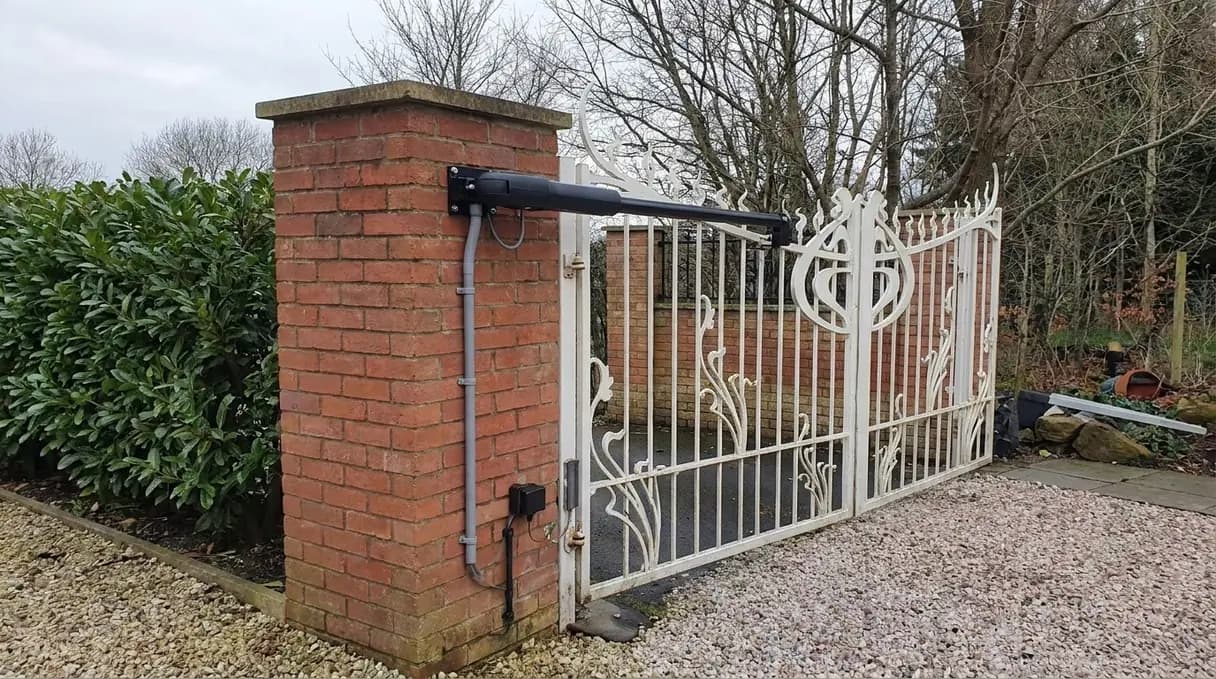
Underground motors sit in a drainage box buried at the foot of each gate post and are almost invisible once fitted, while ram arms are articulated or piston arms mounted openly between the pillar and the gate leaf. Underground kits look far better on ornate iron and stone pillar entrances, but they need excavation, a properly drained box and the gate hung on the motor pivot. Ram arms are cheaper to install and easier to service later, which is why they suit rear entrances and working yards.
Are sliding gate motors different from swing gate motors?
Yes, sliding gates use a completely different drive: a gearbox with a toothed pinion that pulls the gate along a rack bolted to the gate frame. The gate runs on a track set in the ground or on cantilever rollers if the ground cannot be dug. Sliding gates are the answer where a swing gate has nowhere to open into, such as a short driveway that runs straight onto a road, or a steeply rising entrance.
What happens to my gate in a power cut?
Every automatic gate has a manual release so it can be unlocked and pushed by hand when there is no power. On most systems that is a key or a small lever on the motor casing that disengages the drive from the gate. Anyone who uses the gate should be shown where the release is and be able to work it, because a power cut in the dark is a poor time to be reading a manual.
Do automatic gates need photocells and safety edges?
Powered gates need safety devices because they are legally classed as machinery, and photocells and safety edges are the two most common ways of providing that protection. Photocells fire an infrared beam across the opening so the gate stops or reverses when something breaks it, and safety edges are pressure sensitive rubber strips fitted to the closing edges that react on contact. Which combination a particular gate needs depends on the risk assessment for that gate: its weight, its speed, its location and who has access to it.
Is force testing a legal requirement on automatic gates?
Yes, a powered gate must be assessed and force tested so it cannot trap or crush, because in law it is machinery rather than a piece of building hardware. BS EN 12453 sets the limits for how much force a gate leaf may apply and for how long when it meets an obstruction, and those forces are measured on site with a force tester rather than judged by eye. The obligation does not stop at handover either, because the forces change as the gate ages, so they need re-checking through the life of the gate.
Do I need a power supply run out to the gate?
Yes, an automatic gate needs a mains supply at the entrance, normally taken from the property on armoured cable buried in a duct. Where the driveway is long or already surfaced, that cable run is often the biggest single piece of work in the job, so it is worth thinking about before a new drive is laid rather than after. Low voltage cables for photocells, intercoms and keypads run in the same trench, so it is sensible to duct for everything at once even if some of it is fitted later.
Is my gate too heavy to automate?
Weight alone rarely rules out automation, because motors are made for a wide range of leaf weights and widths, but very heavy gates do change what is needed elsewhere. The critical figures are the weight of the leaf, its width, and whether the post or pillar can take the leverage that combination produces. A wide heavy leaf puts an enormous turning load on its hinge point, so on borderline gates the honest answer is often to strengthen the pillar rather than fit a bigger motor.
How long does it take to automate a gate?
A straightforward ram arm installation on gates that are already hung well is usually a one day job, while underground motors with a new cable run and excavation typically take two days or more. What stretches the timescale is groundwork rather than the automation: digging a cable duct across a tarmac drive, casting foundations for underground boxes, or replacing posts that will not carry the load. Commissioning, setting the limits and force testing happen at the end of the fit, not on a later visit.
What affects the cost of automating a gate?
The main factors are the drive type, the distance from the nearest power supply, the ground surface that cable has to cross, and how much access control you want. Underground motors cost more than ram arms because of the excavation and drainage. Beyond that, the gates themselves matter: sound posts and well hung leaves keep the job simple, while gates that need re-hanging or new pillars add work before the automation can even start.
Can I open the gate from my phone, or do I need remotes?
Both are available, and most systems end up with a mixture. Handheld remote fobs are the simplest, keypads suit households where visitors and deliveries need a code, intercoms let you speak to a caller and release the gate from indoors, and GSM or app based modules open the gate from a phone anywhere with a signal. Access control is worth deciding at survey stage, because intercom and keypad cabling is far easier to run before the ducting is closed up.